
Understanding the Different Types of Home Elevators
Introduction
The first time someone I care about seriously considered a home elevator, they assumed there was just one kind. A box that goes up and down. A button. A door. Simple.
Then the installer began explaining options.
Hydraulic. Traction. Shaftless.
Their expression shifted from curiosity to confusion. “I just want something safe,” they said. “Why are there so many types?”
It is a fair question. Elevators are often discussed as a single solution, but the systems behind them differ in how they operate, how they are installed, and how they feel to use. Understanding those differences does not require engineering expertise. It requires clarity about what each system is designed to do and which homes they serve best.
Choosing the right elevator type is less about technology and more about lifestyle, space, and long term plans. This article walks through the three most common types of residential elevators and helps translate technical language into practical understanding.
Why Elevator Type Matters
At first glance, all residential elevators accomplish the same goal. They move people vertically between floors. But how they achieve that movement affects space requirements, ride quality, installation complexity, and maintenance expectations.
The type of elevator you choose influences how it integrates into your home and how it supports your daily routine.
It is not just about moving up and down. It is about how that movement feels and functions over time.
Hydraulic Elevators
Hydraulic elevators are among the most established residential systems. They operate using a fluid driven piston that raises and lowers the cab.
When someone presses the button, hydraulic pressure pushes the cab upward. When descending, the system releases pressure in a controlled manner.
The ride is typically smooth and steady. Many homeowners describe it as solid and grounded.
Hydraulic systems usually require a shaft and space for mechanical components. They are well suited for homes with enough room for dedicated vertical construction.
For homeowners who prioritize durability and a traditional enclosed elevator experience, hydraulic systems often feel reassuring.
The Experience of Hydraulic Operation
Hydraulic elevators tend to move at a consistent pace. The ascent feels deliberate rather than rapid. The enclosed shaft provides a sense of privacy and containment.
For families planning long term aging in place, hydraulic systems often feel like permanent infrastructure. They resemble small scale commercial elevators but are scaled appropriately for residential use.
Their reliability has made them a popular choice for decades.
Traction Elevators
Traction elevators operate using cables and counterweights. Instead of fluid pressure, they rely on a motorized pulley system that lifts and lowers the cab.
Because they use counterweights, traction systems can be energy efficient and responsive.
The ride often feels slightly more dynamic, with gentle acceleration and deceleration. Modern traction systems are engineered for quiet operation.
Traction elevators also require a shaft, but they may not require the same type of machine room as some hydraulic systems.
For homeowners seeking advanced technology with efficient operation, traction systems are often appealing.
The Feel of Traction Systems
Many users describe traction elevators as refined and smooth. The motion can feel slightly lighter than hydraulic movement.
For multi story homes with regular use, traction systems offer a balance between performance and efficiency.
They represent a more modern approach to vertical mobility.
Shaftless Elevators
Shaftless elevators are a newer innovation designed specifically for homes with limited space.
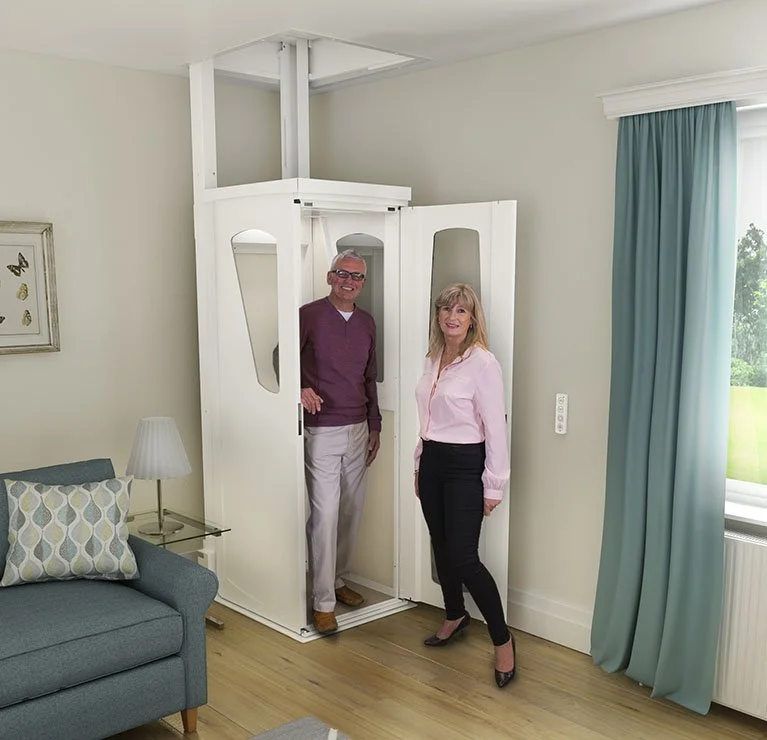
Unlike hydraulic or traction systems, shaftless elevators do not require a fully enclosed shaft. They travel between two floors through a cut out in the floor, often with minimal structural modification.
Their footprint is smaller. Installation is typically faster. They are ideal for homes where building a full shaft would be impractical.
Shaftless systems are most commonly used for two floor applications.
The Experience of Shaftless Design
Shaftless elevators often feel open and integrated into the living space. Some feature transparent panels that allow light to pass through, reducing the sense of enclosure.
Because they do not require large structural shafts, they feel less invasive.
For homeowners who want minimal renovation disruption, shaftless systems are often attractive.
Space Considerations Across Types
Hydraulic and traction elevators generally require more dedicated vertical space because of their enclosed shafts.
Shaftless systems require less overall space but are typically limited to two floors.
The right choice depends on how many levels need access and how much structural modification is feasible.
Understanding your home’s layout is the first step in choosing wisely.
Maintenance and Long Term Care
All elevator systems require regular maintenance. Hydraulic systems may involve fluid checks. Traction systems require inspection of cables and motors. Shaftless systems involve mechanical component reviews.
Maintenance schedules are predictable and manageable when handled by professionals.
Long term reliability depends more on proper installation and servicing than on the specific type chosen.
Matching Elevator Type to Lifestyle
Choosing between hydraulic, traction, and shaftless systems is not about which is best overall. It is about which fits your life.
If your home has multiple floors and space for a shaft, hydraulic or traction may offer robust long term solutions.
If you live in a two story home with limited room for construction, a shaftless system may provide exactly what you need without overwhelming your space.
Lifestyle and layout guide the decision.
Real Life Reflections
I once worked with a homeowner who initially leaned toward hydraulic because it felt familiar. After reviewing their space constraints, a shaftless system proved more practical. Years later, they still describe it as seamless and unobtrusive.
Another family selected a traction system for its energy efficiency and smooth ride. They appreciated the modern feel and quiet operation.
Each choice reflected the home and the people living in it.
Avoiding Technology Overwhelm
Technical terms can make elevator decisions feel complicated. But the core question remains simple.
How many floors need access?
How much space is available?
What level of renovation feels comfortable?
What kind of ride experience feels right?
Answering those questions brings clarity faster than memorizing specifications.
Thinking About the Future
When selecting an elevator type, consider not only present mobility but future possibilities.
Will the system need to accommodate mobility devices?
Is expansion to additional floors possible?
Is energy efficiency a priority?
Forward thinking protects investment.
Conclusion
Understanding the different types of home elevators helps homeowners make confident, informed decisions. Hydraulic systems offer traditional reliability and steady performance. Traction systems provide modern efficiency and smooth operation. Shaftless elevators deliver compact, minimally invasive solutions for two story homes. The right choice depends on space, lifestyle, and long term goals rather than technical superiority.
At KGC, we guide families through these decisions with clarity and care. Our approach focuses on matching the right elevator type to your home’s structure and your future plans so vertical mobility feels seamless and supportive. If you are exploring residential elevator options and want expert guidance tailored to your space, our team is here to help you move forward with confidence.
You can reach our team through the KGC Contact Page.
