
Stairlifts for Narrow Staircases: What Are Your Options
Introduction
I still remember the day I realized how much a simple staircase can shape a home. It was one of those ordinary mornings, soft sunlight slipping through the windows, quiet enough that even small sounds felt meaningful. Someone I love was heading to the upper floor to retrieve a book. The stairs were narrow, the kind with steep risers and a railing pressed close to the wall — the kind many older houses have. For years I had watched them move up that staircase casually, unconsciously. But that day, they paused at the bottom step. Their expression didn’t show fear. It wasn’t uncertainty. It was simply awareness. A little hesitation. A glance upward as though evaluating how safe that climb would be.
I realized in that moment that what once felt like a simple routine had quietly become a negotiation. Every step required more care. Every railing became necessary. The narrowness of the staircase, once a quaint detail of the house’s design, had turned into a limiting factor — not just for comfort, but for independence. I understood that staying in the home we loved would require a thoughtful change. We began to look into stairlifts. But the question loomed: Could a stairlift even work on such a narrow staircase?
Our concerns were not simply about width. We worried about the shape of the rail, the seat needing enough space, the staircase being “too tight” for a device. We envisioned bulky machinery, clearance problems, complicated installation. What we discovered instead was a path forward. A path that honored our home and supported freedom without compromising safety or dignity.
This article explores the options available when your staircase is narrow. It shares what is possible, what needs to be considered, and how stairlifts can transform even restricted spaces into accessible, comfortable, and safe passageways. If you are reading this because you worry your stairs are “too narrow,” know that you are not alone. And know that you are not without choices.
Why Narrow Staircases Present Unique Challenges
Narrow staircases pose many subtle challenges that often get overlooked until mobility becomes a concern. They limit the amount of usable width for walking, carrying items, or installing equipment. They often have steep rises, tight treads, and minimal landing space. Railings may protrude slightly, making the effective width even narrower. These structural characteristics make daily movement more demanding. More importantly, they make people more vulnerable to slips, missteps, or loss of balance — especially when holding items or carrying pressure from fatigue or reduced mobility.
When a family begins considering a stairlift for such staircases, concerns arise quickly. How will the rail fit? Will the seat block the stairs for others in the home? Will the lift feel cramped or unsafe? Will installation require removing railings or damaging walls? These are valid worries. But over the years stairlift technology has evolved. Manufacturers and installers understand these challenges. They offer solutions designed specifically with narrow staircases in mind. They balance engineering precision with human-centered design to deliver mobility without compromise.
Understanding these challenges deeply helps families ask the right questions. It helps them imagine what a successful installation might feel like. And it opens the door to solutions that preserve both home and independence.
Option 1: Slim Rail Stairlifts with Compact Seats
One of the most effective solutions for narrow staircases is the slim rail stairlift combined with a compact seat. These stairlifts are engineered with a narrow profile rail that hugs the staircase closely. The rail’s brackets are designed to anchor directly to the stair treads rather than the wall, which preserves the integrity of the home’s structure. The profile remains minimal, leaving as much free space on the stairway as possible.
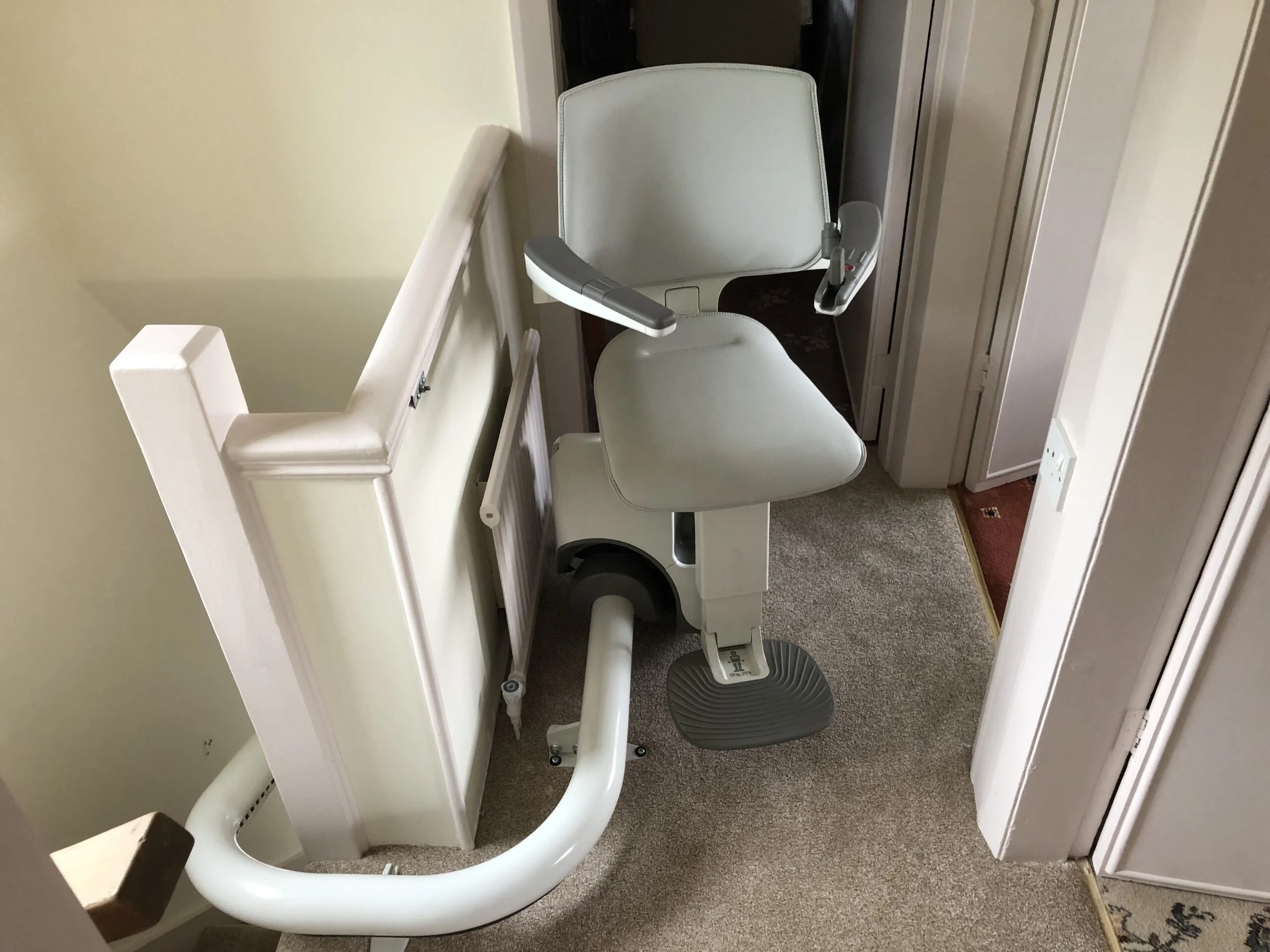
The seat unit in these models is also narrower and often folds neatly when not in use. The footrest and armrests tuck in smoothly, which keeps the staircase passable for others. Because the rail and seat are designed to minimize bulk, even a staircase with tight width can remain functional for multiple household members. The slim rail stairlift provides a balance between space saving and safe mobility.
For many families living in older homes or houses with limited stair width, this option represents the ideal compromise: accessibility without sacrificing the flow of daily living. It keeps the stairs usable. It keeps the home feeling familiar. And it restores mobility without turning the staircase into a dedicated utility lane.
Option 2: Narrow-Track Curved or Straight Stairlifts for Tight Turns
In some homes narrow staircases combine with turns, landings, or small directional shifts. In these scenarios, a standard lift might not work because it requires room for both rail curvature and seat clearance. This is where narrow-track curved or straight stairlifts become particularly valuable. These lifts are designed with tighter tolerances. The rails follow every nuance of the staircase — whether straight, curved, or angled. They are custom engineered to fit precisely. The seat and footrest remain compact. Clearance is measured carefully to ensure safety and usability.
This option is especially useful when the narrow staircase has a 90-degree turn or a small landing. A custom curved rail can wrap around corners with minimal intrusion. The compact seat folds flush against the wall or railing when not in use, ensuring the staircase remains available for other household members. Installers often take extra care to measure steps, railing protrusions, and hallway width to confirm the lift will fit without compromising door clearances or creating hazards.
Although this type of installation requires more precision and often a custom rail design, it offers families a real way to stay in homes with complicated, narrow stairways — without sacrificing safety or mobility.
Option 3: Use of Wall-Mounted Stairlifts or Space-Saving Alternatives
In some particularly narrow staircases where even narrow rail designs seem challenging, there are alternative solutions that may work. Wall-mounted stairlifts offer a different approach. Instead of attaching to the stair treads, the rail is mounted along the wall. This configuration can save space on the staircase itself and allow for clearance where stair tread depth or width is limited.
Another alternative is a standing stairlift. These lifts require less depth because the user stands rather than sits. The platform remains compact, and the rail stays slim. For individuals with sufficient balance and strength in their legs, a standing stairlift can provide safe vertical movement without occupying as much width as a traditional seated lift.
Some modern stairlift options also include external rail offsets. These offset rails shift the seat slightly inward toward the interior side of the staircase, giving more clearance on the opposite side for people walking up or down. This is particularly useful in narrow stairs that must remain accessible to other family members or frequent visitors.
These space-saving alternatives reflect the creative engineering solutions that exist today for staircases once considered too narrow or impractical for stairlifts.
Option 4: Retrofit and Customization to Maximize Usability
Narrow staircases often come with irregularities: uneven steps, protruding railings, tight landings. In these cases, a retrofit or custom stairlift installation can make a big difference. Experienced installers can work around irregular shapes or dimensions, crafting rails tailored to each curve, shift, or step. They may suggest slight adjustments like repositioning handrails or modifying stair treads to optimize clearance, but these changes are minimal, reversible, and far less invasive than major renovation.
They may also adapt seat width, footrest size, or mounting brackets to fit the space neatly. The result often feels less like an add-on and more like a thoughtful part of the home. For many families, this customized approach makes a previously impossible staircase accessible again without altering the home’s charm or layout significantly.
What Installation Looks Like on a Narrow Staircase
Watching a stairlift being installed on a narrow staircase can feel full of careful intention. The installer begins by examining every detail: railing width, stair tread depth, landing clearance, overhead space, door positions, and hallway flow. They measure more than once. They consider every angle. They sometimes suggest folding elements or offsets to create safe passage for others in the home.
The rail is anchored directly to the stairs. Nothing is removed from walls. The foldable seat and footrest sit quietly against the wall or railing when not in use. The profile remains slender. The staircase keeps its original character. It does not feel like a remodel. It feels like an adaptation.
When the stairlift is first used, the ride is gentle. The seat glides smoothly even on tight turns or when the rail passes close to the wall. The user sits comfortably. The movement is stable. And most importantly, the staircase remains usable for others.
From the outside it may not even be obvious that a lift has been installed. That subtlety matters. It allows the home to remain a home — not a care facility.
Safety and Comfort With Narrow Stairlifts
Safety remains the top priority. Narrow-profile rails undergo the same testing as standard lifts. They support weight reliably. They include sensors that detect obstacles. Their motors operate smoothly. Their seatbelts, armrests, and footrests remain stable. The narrow design does not compromise structural integrity.
Installers verify weight capacity, seat stability, clearance, and obstruction detection. They walk through scenarios: a person stepping onto the stair from above or below, someone passing on foot while the lift is parked, carrying objects while others use the stairs, and nightly routines. They confirm that every movement is safe, every exit and entry point clear, and every family member comfortable with the setup.
Comfort also matters. Narrow seats are designed to support posture. Folding footrests retract without effort. Swivel mechanisms remain smooth. Ride speed balances safety with dignity. The goal is a lift that feels natural and supportive.
Even in tight staircases, narrow-profile stairlifts provide a ride that builds confidence rather than limiting freedom.
Maintaining the Stairlift in a Narrow Staircase
Maintenance on a stairlift mounted in a narrow staircase is the same as on any other lift. The rail needs occasional cleaning. The seat and footrest can be wiped down. The motor, batteries, and safety sensors remain protected. Foldable components continue to function smoothly. Annual maintenance visits keep the system running optimally.
Because narrow staircases sometimes experience more frequent use — especially if the stairlift becomes the preferred route — it is helpful to remain attentive to clearance and ensure nothing is obstructing the rail. But otherwise, the upkeep remains low and straightforward. The narrow design does not increase maintenance burden. The lift remains a quiet helper, not a constant project.
When a Narrow Staircase May Still Pose Limitations
No stairlift solution is completely universal. There may be staircases so narrow or steep that even narrow-profile or wall-mounted lifts do not fit safely. Very tight stairways with extremely shallow treads or minimal overhead height can pose challenges. In these cases, families may need to consider alternative mobility solutions such as relocating primary living spaces to the ground floor, using a home elevator or platform lift, or changing rooms to accommodate mobility needs.
During the consultation process the installer evaluates all structural limits: tread depth, riser height, width, handrail positioning, door clearances at landings, and overhead space. A safe and effective lift installation is possible only when all these elements can support the design without sacrificing safety.
In rare circumstances where a stairlift cannot be safely installed, families may still have other options. It does not mean mobility must be compromised. It means a different approach is needed — one that respects safety above all else.
Real Families, Real Transformations
I worked with a family who lived in a small heritage home with extremely narrow stairs. The staircase twisted slightly, had steep risers, and only allowed a narrow path when carrying groceries or laundry. The older member of the household worried they would have to move to a different house because the stairs felt like an obstacle they could not overcome.
After assessing the dimensions, the installer recommended a slim rail stairlift with a compact seat and foldable footrest. The installation went smoothly. The rail hugged the stairs closely. The seat tucked against the wall when folded. The staircase remained usable for others. Once installed, the person using it rode as confidently as anyone on a standard staircase. The family regained peace of mind. The home stayed intact. The loved one stayed in their familiar space. It was a transformation that did not require renovation — only understanding and thoughtful adaptation.
Another family lived in a townhome with a narrow curved staircase that led to a loft bedroom. They worried a lift would block the stairs entirely. The installer proposed a custom curved narrow-track stairlift with wall-mounted offset. The project took careful measurement and precision fabrication, but the final result felt like it belonged. The staircase regained accessibility. The loft bedroom remained part of daily life. The home did not lose its charm. Instead, it welcomed a new sense of safety.
These stories show how modern stairlifts make narrow staircases accessible without compromising identity or comfort. They show that thoughtful adaptation matters more than assumptions of limitation.
Why Professional Assessment Matters More Than Assumptions
When a family looks at a narrow staircase, it is easy to assume it is impossible. Walls seem too close. Steps too steep. Space too tight. But making assumptions without professional evaluation can close doors prematurely. Stairlift professionals have seen countless narrow staircases and know the engineering solutions that make installation possible.
During a careful assessment they measure stair width, step depth, handrail protrusion, headroom, overhead clearance, landing space, entry and exit points, and path flow. They consider everyday use — how many people move on foot, how often the lift will be used, whether other mobility aids may share the stairs. They review safety, clearance, comfort, and long term usability.
This evaluation is not about selling a product. It is about understanding possibilities. Many homes once thought inaccessible find solutions when a specialist examines the structure with a fresh perspective.
The Emotional Impact of Accessibility in a Tight Home
For many people, a narrow staircase is part of what makes their home feel cozy, familiar, and full of character. It is part of the memory of raising children, hosting friends, and passing down traditions. When mobility changes, the staircase can become a symbol of limitation rather than comfort. Suddenly it feels like a barrier rather than a bridge.
A thoughtfully installed stairlift transforms that barrier back into a bridge. It protects memories. It preserves the home’s character. It restores movement. It restores independence. It restores dignity.
Families often describe the installation as one of the most transformative decisions they have made — not because it required overhaul, but because it allowed life to continue gracefully, comfortably, and without compromise.
Conclusion
Narrow staircases present unique challenges, but they are far from insurmountable. With modern stairlift technology, careful planning, and professional expertise, even tight, steep, or curved staircases can become accessible, safe, and functional again. Slim rails, compact seats, wall-mounted options, custom curved tracks, and careful installation practices open possibilities for homes once considered too small or too tricky.
At KGC, we believe that mobility should adapt to the home — not the other way around. We respectfully evaluate each staircase, listen to each family’s story, and design stairlift solutions that support comfort, dignity, and independence without requiring major renovation or sacrificing the home’s character.
If you are ready to explore stairlift options for your narrow staircase, we are here to guide you with care, expertise, and compassion.
You can reach our team through the KGC Contact Page.
