
Can a Stairlift Be Installed on a Spiral Staircase
Introduction
There is a quiet moment many families remember when they begin thinking about stairlifts. It often happens on an ordinary day, in the soft in-between spaces of daily life. I remember a moment like that vividly. Someone close to me was carrying a small basket of folded laundry toward a staircase that curled upward in a beautiful spiral. It was the kind of staircase that looked elegant and graceful, the kind of architectural detail people admire for its charm. But that day, charm was not what caught my attention.
They reached the first step and paused. It was a small pause, subtle and almost unnoticeable, but full of meaning. Their hand reached for the railing more slowly than usual. Their body leaned slightly, searching for balance. The spiral staircase, once a thing of beauty, suddenly felt complicated. Curved steps. Narrow treads. A railing that wrapped around tightly. The climb was no longer automatic. It required thought. It required caution. And in that moment I understood that the staircase, although lovely, had become a barrier.
Later, they confessed that going up and down those stairs had begun to feel less safe. They worried about the curve. They worried about the tight inner radius. They worried that one slip could lead to something far worse. Yet they also loved their home deeply. They did not want to move their bedroom downstairs. They did not want to leave the home they had poured their life into. What they wanted was simple. They wanted to stay. They wanted safety. They wanted independence.
The question became clear. Could a stairlift even work on a spiral staircase
We began searching for answers. We assumed the answer would be no. Spiral staircases twist tightly and rise unevenly. They vary in width. They create very little linear path for a traditional stairlift rail. We thought that meant a stairlift was impossible. What we discovered instead was a world of possibility we did not know existed.
This article explores that journey and explains how stairlifts can, in fact, be installed on spiral staircases. It also shows what homeowners should consider, how the installation works, and why the right lift can transform a challenging staircase into a safe and empowering part of the home.
Why Spiral Staircases Are Different From Traditional Stairs
Spiral staircases create a special kind of beauty in a home. They curve upward gracefully, saving floor space while creating visual charm. But their beauty comes with structural quirks that make mobility more complicated.
Most traditional staircases follow a straight or gently curved path with uniform depth on each step. Spiral staircases are built differently. The steps narrow toward the center and widen outward. The inner edge is often too tight for walking comfortably, while the outer edge can feel exposed. The railing curves constantly. The climb requires rotational movement rather than a straight ascent. Some spiral staircases are steep. Others are narrow. Many lack a standard rhythm that people rely on for balance.
These characteristics make using them harder as mobility changes. The tilt of the body required to ascend the spiral can make balance more unpredictable. The inward narrowing of the steps often causes missteps. The railing may not always provide firm support throughout the curve. All these factors create an environment where slips are more likely.
Stairlift installation must account for all these complexities. Which means the solution needs to be extraordinarily precise, custom crafted, and engineered specifically to follow the curve of the staircase. This is why not all stairlift models work on spiral stairs. But with the right technology and expertise, installation is entirely possible.
The Key to Spiral Staircase Stairlifts: Custom Curved Rails
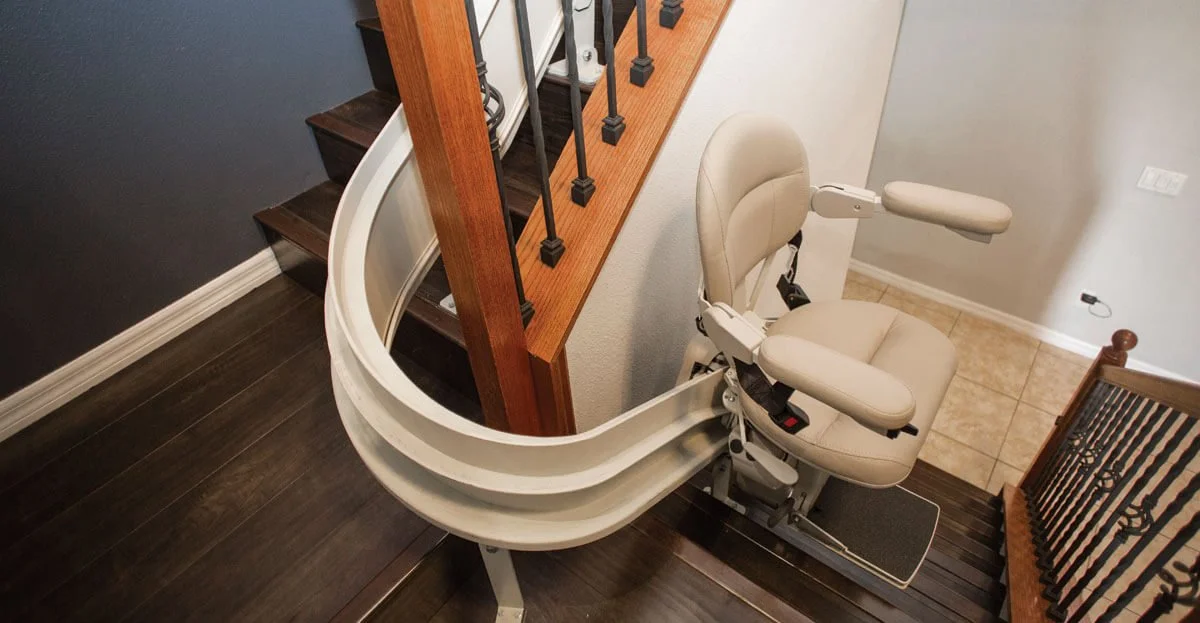
The most important element of installing a stairlift on a spiral staircase is the rail. Unlike straight staircases where the rail can be a standard length, spiral staircases require a rail that is custom measured, designed, and built to match every curve of the staircase.
A custom curved rail is fabricated as a single continuous piece or as segmented pieces engineered to form a smooth line that mirrors the spiral path. This rail must sit at the correct height, follow the exact radius of the curve, maintain safe distance from the railing and wall, and allow enough clearance for the seat and footrest.
The engineering behind these rails is meticulous. Technicians use digital measuring tools to capture the precise geometry of the staircase. They measure angle, pitch, radius, height, and spacing. They examine the layout of each step. They study how the staircase interacts with hallways, door frames, and landings. Then they design a rail that fits that specific home and no other.
This level of customization is what makes stairlift installation possible on spiral staircases. Without it, the tight turns and variable widths would make safe travel impossible. With it, the stairlift glides upward smoothly, following the staircase as though it were designed with the lift in mind from the beginning.
How Seats Adapt to Spiral Staircases
Once the rail has been designed, the next challenge becomes the seat. The seat must move along the rail comfortably without bumping into walls or railings. It must rotate at the right angle at the top and bottom landings. It must fold neatly when not in use so that others can still move through the staircase if necessary.
Modern stairlift seats are designed with these challenges in mind. They include swivel functions that allow users to turn safely onto the landing. They include foldable footrests and armrests that tuck inward. They are built with compact profiles so they do not obstruct narrow paths.
Some models have extra rotational flexibility, allowing the seat to adjust automatically as it travels along a curved or spiral path. This ensures that the user remains upright and balanced throughout the ride.
This ability to adapt is what makes stairlifts feel safe and comfortable on spiral staircases. Users do not feel twisted or angled awkwardly. They feel supported, secure, and stable.
Safety Considerations Unique to Spiral Staircases
Safety is always the most important part of stairlift design, but spiral staircases introduce additional considerations. Because spiral stairs often have uneven footing and smaller treads, the stairlift must protect the user from slipping during entry and exit. Because the staircase curves, the rail must maintain a consistent distance from obstacles. And because spiral staircases can be narrow, the stairlift must leave enough clearance for safe movement.
One of the most important safety features is the swivel seat. When the user reaches the top landing, the seat turns outward so they can step onto flat flooring rather than stepping onto a curved or narrow stair surface. This reduces the risk of imbalance. At the bottom landing, the seat must align properly so the user can safely sit down.
Sensors also play a critical role. Stairlifts use obstruction sensors that detect any object on the stairs or rail. If something is detected, the lift stops immediately. This ensures safe passage even when the staircase is tight or when other household members move through the area.
Battery systems provide additional safety, ensuring that the stairlift remains operational even if the home loses power temporarily.
Together, these features create an environment where the user feels cared for and protected during every moment of their ride.
When a Spiral Staircase Stairlift Is the Best Solution
Many families assume that spiral staircases automatically require major home renovation or relocation of essential rooms. But a stairlift can often preserve the home’s layout without requiring such drastic changes.
A stairlift is often the best option when the spiral staircase is the main access to important areas such as a bedroom, bathroom, or laundry room. For someone who wishes to age in place or maintain independence, losing access to upper or lower levels can be emotionally difficult. A stairlift restores that access.
It is also the best option when the staircase cannot be widened or restructured. Spiral staircases are often load-bearing architectural elements, which means altering them would require extensive and costly renovation. A stairlift allows homeowners to keep their staircase intact while improving safety dramatically.
Families also choose stairlifts for spiral staircases when space is limited. Spiral staircases are often installed in homes with tight floor plans. A stairlift supports mobility without sacrificing the compact nature of the home.
When a Spiral Staircase Stairlift May Not Be Possible
Although many spiral staircases can support stairlift installation, there are rare situations where installation may not be recommended. These include extremely narrow staircases where the rail cannot be installed at a safe distance from obstructions, staircases with insufficient headroom or landing space, staircases that are too steep or structurally weak, or staircases that interfere with doors or hallways in a way that compromises user safety.
In such cases, a professional assessment is essential. Technicians can determine whether modifications can be made safely or whether another mobility solution would be more appropriate.
Even when a spiral staircase cannot accommodate a stairlift, families often still have alternatives such as home elevators, vertical platform lifts, or reconfiguration of rooms. The most important step is getting expert guidance.
What to Expect During the Installation Process
The installation process for a spiral staircase stairlift feels thoughtful, detailed, and surprisingly calm. After the initial consultation and digital measurements, the custom rail is built offsite. Once completed, the installation is usually completed in a matter of hours.
The installer anchors the rail securely to the staircase treads. They align the rail precisely with the curve of the stairs. They attach and test the seat. They connect the electrical components and charging system. They verify every safety feature. They demonstrate how to use the lift. And they guide the user through their first ride so it feels comfortable and natural.
Because the staircase is spiral, installers work carefully to ensure the seat does not bump into railings or walls and that the user’s movement remains smooth throughout the journey. The completed stairlift often blends beautifully with the staircase, preserving its charm while vastly improving safety.
Real Experiences From Spiral Staircase Installations
I once met a family who lived in a home with a tall, narrow spiral staircase that wound like a ribbon from the main floor to a loft bedroom. The loved one who needed mobility assistance had begun feeling unsafe climbing the stairs, yet the bedroom held deep emotional meaning for them. They worried that the only option was moving to a different room or a different home entirely.
When they learned that a custom curved stairlift could be attached to their spiral staircase, their relief was immense. The installation took careful planning, but the final result preserved daily life in a way they once believed impossible. The first time they rode the lift, their face lit with a sense of possibility that had been missing for months.
Another family faced a similar challenge. Their staircase wrapped tightly around a central column with steps that varied from narrow to wide. They assumed the staircase was too tight for any equipment. But after a digital assessment, the installer determined that a compact custom rail could fit the path. The stairlift installation allowed the family member to continue accessing their lower floor hobbies and workshop, restoring a sense of purpose and independence.
These experiences show that even complicated staircases can become safe and accessible with the right solutions.
How Spiral Staircase Stairlifts Support Aging in Place
Aging in place is about more than staying in a home. It is about staying connected to routines, memories, and identity. Spiral staircases often lead to spaces that hold personal significance. Bedrooms. Reading nooks. Craft rooms. Family keepsake spaces. When mobility changes make those areas inaccessible, the emotional loss can be profound.
A stairlift restores access gently and respectfully. It allows the individual to remain part of the full home rather than being confined to one level. It preserves dignity by supporting movement without requiring assistance from others. It keeps life full rather than limited.
Families often describe stairlifts as life-changing not because they introduce something new, but because they return something that was quietly slipping away: choice.
Maintenance and Longevity of Spiral Staircase Stairlifts
Maintenance for a spiral staircase stairlift is similar to maintenance for any curved stairlift. The user performs simple tasks such as keeping the rail dust free and ensuring the lift is parked at a charging point. Technicians provide periodic professional maintenance to keep the lift in excellent condition. Batteries are replaced every few years. Sensors are checked. Rail alignment remains stable because the rail is built to fit the staircase precisely.
These stairlifts are designed to last many years, even with daily use. Their reliability is one of the reasons families trust them as long term mobility solutions.
Why Professional Assessment Is Essential
The success of a spiral staircase stairlift depends entirely on expertise. No two spiral staircases are the same. Their design varies significantly from home to home. Only a trained professional can determine the safest and most effective configuration.
During the assessment, the technician evaluates step dimensions, curvature, rail placement, landing space, headroom, entry and exit angles, and home layout. This detailed evaluation ensures that the stairlift will not only fit but will operate safely and comfortably.
Professional evaluation removes guesswork. It answers the questions that families worry about. And it creates a plan tailored specifically to the home’s unique structure.
Conclusion
A spiral staircase may seem like an impossible place for a stairlift, but with today’s technology and expert installation, it is not only possible but often remarkably effective. Custom curved rails. Compact seats. Precision measurement. These innovations make it possible for people to continue using their homes fully and safely even when the staircase curves tightly or climbs steeply.
At KGC, we believe that mobility solutions should adapt to your home, not force you to change it. We approach spiral staircase installations with care, precision, and genuine respect for your independence and comfort. Our goal is to help you continue living where your memories, routines, and sense of belonging already live.
If you would like to explore whether your spiral staircase can support a stairlift, our team is ready to guide you with kindness and expertise.
You can reach us through the KGC Contact Page.
