
Ceiling-Mounted vs. Freestanding Patient Lifts: Which One Do You Need?
Introduction: A Decision That Often Begins With Care
The conversation usually starts during a moment of quiet realization.
A caregiver stands beside a bed after helping with a transfer that felt heavier than expected. Nothing dramatic happened. No emergency occurred. Yet something shifted internally. The movement required more strength than before, more focus, more caution.
Caregiving often evolves slowly. What once felt manageable begins to demand more physical effort. Families begin searching for solutions that protect everyone involved without changing the warmth of home life.
That search often leads to one important question.
Should we choose a ceiling-mounted lift or a freestanding patient lift?
At first glance, the difference appears technical. One attaches to the ceiling. The other rolls across the floor. Yet behind this choice lies something deeper than equipment specifications. It is a decision about safety, independence, lifestyle, and how care will feel day after day.
Understanding the real-life experience of each option helps families move forward with confidence rather than uncertainty.
Understanding the Purpose of Patient Lifts
Patient lifts exist for one essential reason: to make transfers safe.
Transfers happen constantly throughout the day. Moving from bed to wheelchair. Transitioning into the bathroom. Settling into a favorite chair. Each movement requires coordination between caregiver and individual, and each carries potential risk when done manually.
Without lifting equipment, caregivers rely on strength, balance, and timing. Even experienced caregivers can experience strain or injury over time. Patient lifts remove the need for physical lifting while preserving human connection during care.
Both ceiling-mounted and freestanding lifts achieve this goal, but they do so in very different ways.
Choosing between them means imagining how care will unfold inside your unique home.
The Feeling of a Ceiling-Mounted Lift
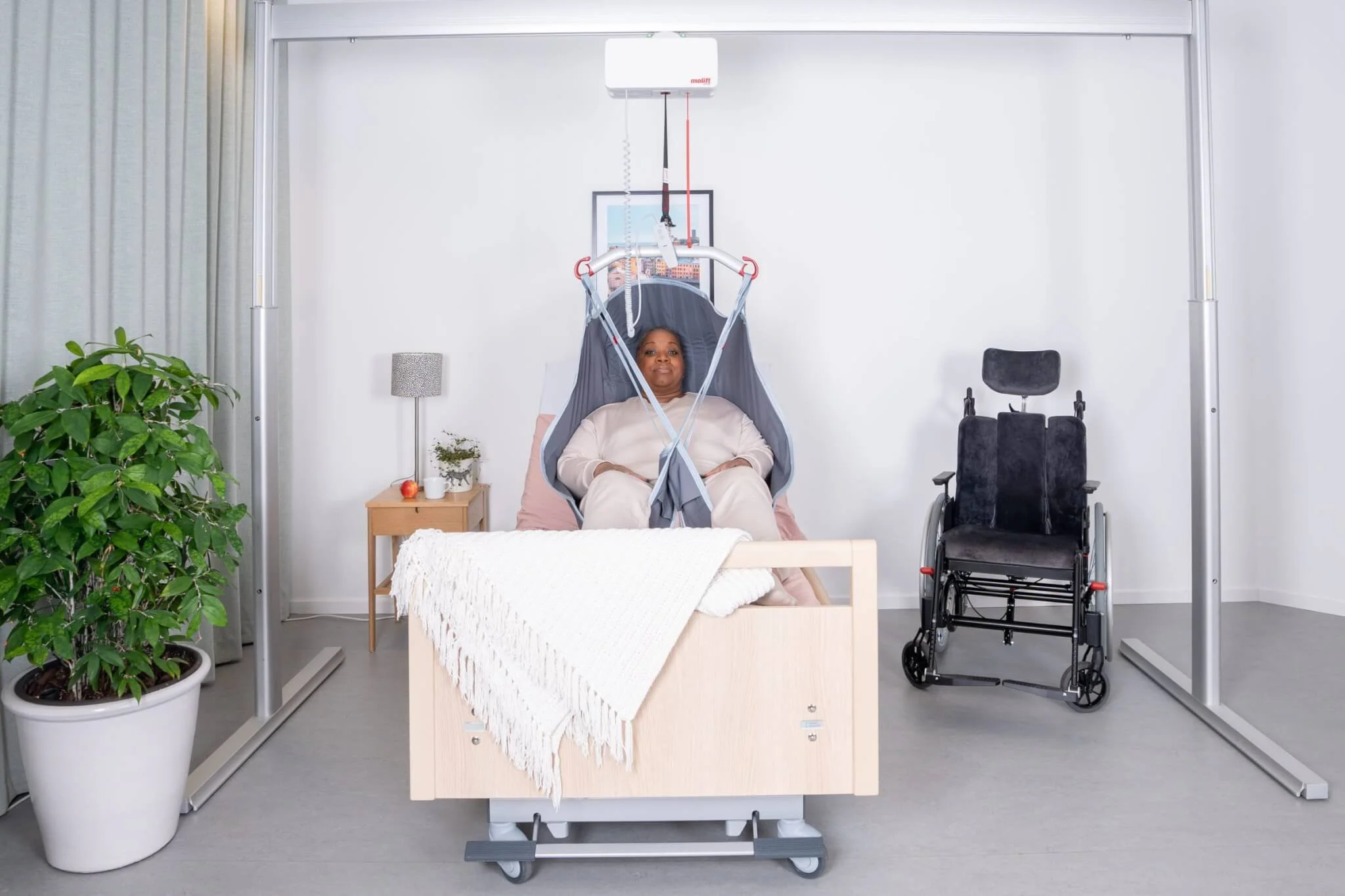
A ceiling-mounted lift becomes part of the home’s architecture.
A discreet track runs along the ceiling, guiding a motorized lift between key locations. The individual is comfortably supported in a sling while the lift glides smoothly overhead. The caregiver operates the system gently, guiding movement without physical exertion.
Many families describe the experience as surprisingly calm. Transfers feel fluid and predictable. There is no need to reposition equipment or clear floor space beforehand. The lift is always ready.
Imagine walking into a room where assistance is quietly built into the environment. Nothing feels temporary or improvised. Care becomes integrated rather than added on.
Over time, the ceiling-mounted lift fades into the background of daily life, much like lighting or heating systems. It supports without demanding attention.
The Experience of a Freestanding Lift
A freestanding lift offers a different kind of reassurance.
Instead of being installed overhead, the lift sits on a wheeled base that moves from room to room. It can be positioned wherever assistance is needed, then stored or relocated as circumstances change.
For families uncertain about long-term needs, this flexibility can feel comforting. The lift adapts to evolving routines without requiring structural modification to the home.
Using a freestanding lift feels similar to pushing a stroller or rolling a piece of luggage. The caregiver positions the base, secures the sling, and guides the transfer carefully.
While effective and safe, freestanding lifts require more physical maneuvering than ceiling-mounted systems. Floor space becomes part of the equation. Furniture placement and room layout influence how smoothly transfers occur.
Still, for many households, portability provides valuable freedom.
Comparing Movement Through Everyday Life
The difference between these two lift types becomes clearer when imagining daily routines.
A ceiling-mounted lift allows seamless movement between predefined areas. Someone can be transferred from bed to wheelchair, then along a track into the bathroom without interruption. The motion feels continuous, almost effortless.
A freestanding lift involves distinct steps. The caregiver brings the lift into position, adjusts the legs around furniture, completes the transfer, then moves the equipment again for the next task.
Neither approach is inherently better. Each reflects a different philosophy of care.
One prioritizes permanence and ease. The other prioritizes adaptability.
Understanding which philosophy aligns with your home often guides the right decision.
Caregiver Safety Over Time
Caregiver wellbeing sits at the center of this choice.
Ceiling-mounted lifts eliminate nearly all physical lifting effort. Because the system moves overhead, caregivers avoid pushing heavy equipment or adjusting wide bases. Transfers require minimal strain, even during repeated daily use.
Freestanding lifts still protect against heavy lifting but may require caregivers to maneuver equipment, particularly on carpeted surfaces or in smaller rooms. Over time, pushing and positioning can create mild physical fatigue, though far less than manual transfers.
Families often think about safety in terms of today’s needs. Yet considering how caregiving may evolve months or years ahead can be equally important.
The safest solution is often the one that remains comfortable to use long term.
Space and Home Layout Considerations
Every home tells its own story through layout and design.
Ceiling-mounted lifts work best when installation areas align with daily routines. Bedrooms, bathrooms, and living spaces connected by track systems create highly efficient transfer paths.
Freestanding lifts shine in homes where structural installation is not feasible or where multiple rooms require occasional assistance rather than constant transfers.
Some homes embrace open layouts that welcome mobile equipment easily. Others benefit from overhead systems that free floor space entirely.
Rather than forcing a home to fit equipment, the ideal solution allows equipment to complement the home’s natural flow.
Emotional Comfort and Confidence
Equipment decisions are rarely purely practical. Emotional comfort matters deeply.
Ceiling-mounted lifts often feel reassuring because they reduce unpredictability. The lift is always in place. Caregivers do not worry about positioning errors or limited space. Individuals receiving assistance feel secure knowing transfers follow a consistent path.
Freestanding lifts offer emotional flexibility. Families appreciate knowing they can adjust the system as needs change or relocate it if living arrangements evolve.
Both systems support dignity, but they do so through different emotional experiences.
One offers stability. The other offers adaptability.
Installation and Long-Term Vision
Installing a ceiling-mounted lift requires thoughtful planning. Professional teams assess structural support, track placement, and future accessibility goals.
While installation involves preparation, many families view it as an investment in long-term independence. Once installed, daily operation becomes remarkably simple.
Freestanding lifts require little installation beyond setup and training. They can be introduced quickly, making them appealing when immediate support is needed.
The decision often reflects how families envision the future. Those planning for sustained home caregiving frequently lean toward ceiling-mounted systems, while those seeking immediate flexibility may begin with freestanding options.
Independence for the Person Receiving Care
Perhaps the most meaningful difference appears in how individuals experience mobility.
Ceiling-mounted lifts can enable greater participation in daily routines because transfers happen smoothly and consistently. Some individuals even learn to operate controls independently, strengthening autonomy.
Freestanding lifts still support independence but rely more heavily on caregiver positioning and preparation.
The right choice is the one that encourages participation rather than hesitation.
Mobility solutions should expand life, not complicate it.
Maintenance and Everyday Practicality
Both lift types are engineered for reliability, yet their daily practicalities differ.
Ceiling-mounted systems remain in place, always charged and ready. There is no storage requirement or concern about battery transport between rooms.
Freestanding lifts require designated storage space and occasional repositioning for charging. These small tasks become part of routine care but are easily managed by most households.
Understanding these rhythms helps families visualize how each system fits into everyday living.
When Families Combine Both Options
Interestingly, some homes benefit from using both lift types together.
A ceiling-mounted lift may serve primary areas such as bedroom and bathroom, while a freestanding lift supports occasional transfers elsewhere.
This blended approach reflects a growing understanding that accessibility solutions can evolve over time. Care does not remain static, and equipment choices can adapt alongside changing needs.
Choosing With Confidence
The question is not which lift is universally better. The question is which lift supports your unique caregiving story.
Families who value seamless daily transfers and long-term caregiver protection often find ceiling-mounted systems transformative.
Families who prioritize portability, flexibility, or temporary solutions often appreciate freestanding lifts.
Both choices reflect care, intention, and commitment to safety.
The most important step is having an open conversation with accessibility specialists who listen first and recommend solutions based on real living experiences rather than assumptions.
Conclusion: Finding the Right Lift With KGC
Choosing between a ceiling-mounted and freestanding patient lift is ultimately about creating a safer, more supportive home environment where caregiving feels sustainable and dignified.
Both systems reduce injury risk, improve comfort, and strengthen independence. The right solution is the one designed around your home, your routines, and your goals.
At KGC, accessibility is never treated as a standard package. Every recommendation begins with understanding how families live, move, and care for one another. KGC’s team designs customized mobility solutions that balance safety, functionality, and style, ensuring equipment enhances the home while protecting caregivers and empowering individuals.
Whether exploring a permanent ceiling-mounted system or a flexible freestanding lift, KGC provides guidance, installation expertise, and ongoing support every step of the way.
Start your personalized accessibility consultation today by visiting the KGC Contact Page.
