
The Most Overlooked Safety Features in Modern Stairlifts
Introduction
There is a moment I remember vividly, even though it passed quietly and without any alarm. It was one of those unremarkable afternoons when the house felt still, sunlight coming in through the living room windows, and the gentle background hum of the day wrapping itself around everything. Someone I love was moving slowly through the space, gathering a few things before heading upstairs. Nothing unusual. Nothing concerning. But what caught my attention was the way their hand hovered over the railing a moment longer than it used to, not because they lacked the strength to climb the stairs, but because they were sizing up the steps in a way they never had before.
It was not fear. It was not weakness. It was awareness. An awareness that moving up the stairs required just a little more thought than it used to. I remember standing there, wondering if this shift had been happening for longer than I realized. Had we simply not seen it, or had it crept in little by little until it became part of the routine? That moment stayed with me, not because anything bad happened, but because nothing had to happen for me to notice something important.
When we eventually started learning about stairlifts, we discovered what many families discover. Stairlifts are not just about getting up and down a staircase. They are about preserving confidence, protecting independence, and ensuring that home remains a place of comfort rather than concern. And what surprised us most was not how many features stairlifts had, but how many of those features are overlooked, even though they can make all the difference in keeping someone safe.
Modern stairlifts are built with careful engineering and thoughtful protections. Some of these features are obvious, like the secure seat or the smooth ride. But many safety components quietly do their job in the background without anyone noticing them. These unrecognized features are often the reason people feel steady, supported, and protected every time they use their lift.
This guide explores those overlooked safety features. You may recognize some of them. Others may be new. But all of them work together to support a safe and comfortable experience that restores independence rather than limiting it.
The Quiet Strength of Obstruction Sensors
One of the most significant yet frequently overlooked safety features in modern stairlifts is the set of obstruction sensors. These small, almost invisible sensors sit underneath the footplate, along the chassis, and sometimes along the seat itself. Their entire purpose is to detect anything that is in the way and stop the lift before it makes contact.
Most people never think about these sensors because they never have to use them. But their value lives in the unpredictability of daily life. A child’s toy. A dropped piece of clothing. A pet resting on a step. Something left on the staircase without anyone realizing it. These sensors are the watchful eyes of the stairlift, ensuring that even a moment of distraction never becomes a moment of danger.
Families who live in busy homes often find great comfort in these sensors. They create a layer of protection that feels natural and nonintrusive. The lift simply stops when something blocks its path. No alarms. No jolts. Just a quiet and immediate pause until the path is clear again.
It is a feature that works so seamlessly that people rarely appreciate how much engineering goes into it. But its role is essential. It ensures every trip on the stairlift is free from sudden surprises and maintains confidence even in the most active households.
The Importance of Controlled Start and Stop Movement
Another safety feature that often goes unnoticed is the controlled start and stop mechanism. Without it, a stairlift might jolt or move abruptly. Modern stairlifts, however, begin and end their movement with a gentle glide. It is subtle. Many people describe it as feeling like a soft exhale. There is no lurch. No sudden pull. No uncomfortable shift in momentum.
The importance of this cannot be overstated. It protects people with sensitive joints, reduced balance, or recovering muscles. It ensures that every ride feels smooth, predictable, and calm. For individuals who rely on stability, this gliding motion provides confidence long before the lift even reaches the top of the stairs.
Families often do not realize how vital this feature is until they see someone use the lift for the first time. They notice the sense of ease, the relaxed shoulders, the steady position. It is one of the quiet ways stairlifts preserve dignity and allow someone to feel fully in control of their movement.
The Protective Role of Swivel Seats
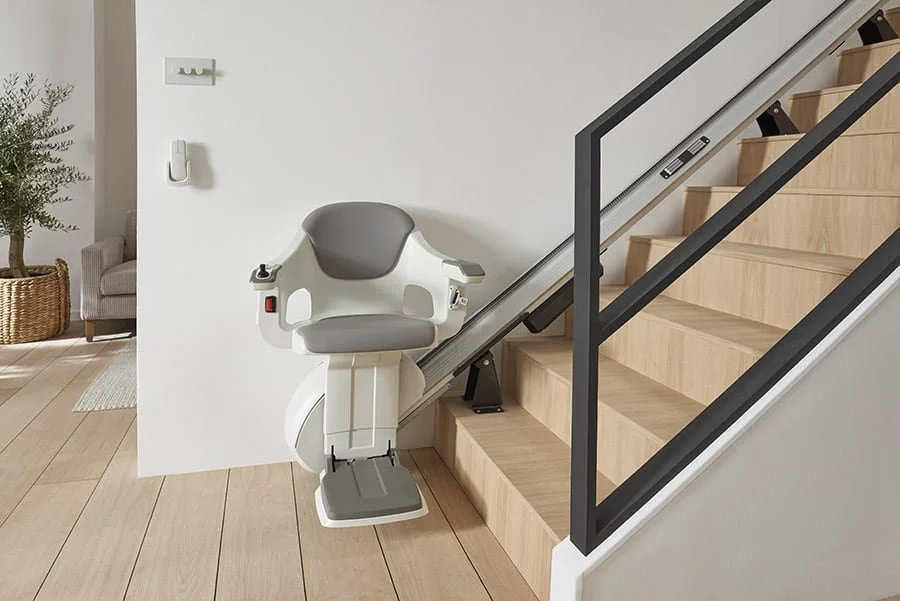
Swivel seats are one of the most helpful and safety centered elements in modern stairlifts, yet they rarely draw the attention they deserve. At the top of the staircase, stepping off a stairlift requires stability and confidence. A swivel seat makes this transition safe by turning the seat toward the landing, securing it in place, and providing a comfortable position to stand safely.
Without this feature, someone might have to step off sideways, turning their body at an angle that could be challenging, especially for those with limited strength, reduced balance, or joint discomfort. The swivel seat removes that challenge entirely. It ensures that the user exits the lift in a natural and straightforward posture, facing the hallway rather than the stairs.
Many modern stairlifts include power swivel features. This means the seat turns automatically with the press of a button, reducing the physical effort required. This support makes an enormous difference for people who may struggle with upper body strength or who want to avoid twisting movements.
The swivel seat may appear to be a small convenience, but it is actually one of the most powerful safety features. It protects the user at the most vulnerable moment of the journey and ensures that getting on and off the lift always feels secure.
The Security of Footrest Safety Sensors
The footrest plays a larger role in safety than most people realize. It is designed to fold up when the lift is not in use to keep the staircase passable and reduce tripping hazards. But hidden within the footrest are additional sensors that detect obstacles directly in front of the lift. These front edge sensors are particularly important for families with pets, items stored near the staircase, or tight stairwells.
If the footrest comes into contact with anything, it automatically signals the lift to stop. This prevents accidents long before they occur. The user may not even realize how many times this feature has protected them because it works so quietly and so intuitively.
There are also models with power folding footrests, allowing the footrest to tuck itself away with ease. This removes the need for the user to bend or reach down, which is especially important for those who experience discomfort when leaning forward or who have challenges with flexibility.
In a world where staircases are often shared and busy, footrest sensors keep the environment safe for everyone, not just for the person using the lift.
The Subtle Support of Seatbelts Designed for Ease
Seatbelts may sound straightforward, but the way modern stairlift belts are designed reflects a deep understanding of real-world accessibility needs. Traditional seatbelts can be stiff or awkward for people with limited mobility, arthritis, or reduced dexterity. Modern stairlifts offer seatbelts that are intentionally crafted for ease, featuring accessible buckles, soft movement, and intuitive design.
Many stairlifts include retractable seatbelts that pull out with minimal effort and fasten securely with a single motion. Some models even offer advanced tensioning systems that adjust themselves without requiring intricate handling.
The importance of a comfortable seatbelt cannot be underestimated. It encourages consistent use. It reinforces confidence. And it ensures that individuals feel secure at every moment of their ride.
Families often overlook this feature until they see how naturally someone can secure the belt without strain. What looks like a simple design improvement is actually a thoughtfully engineered safety component that honors both comfort and independence.
The Value of Battery-Powered Backup Systems
Modern stairlifts are designed with reliable battery powered backup systems. This feature ensures the lift continues to operate even during a power outage. It is one of the most overlooked, yet most essential, safety protections available.
Power outages happen unexpectedly. Weather changes. Electrical panels trip. Appliances overload circuits. In those moments, relying solely on traditional power could leave someone stuck on one level of the home. The battery backup prevents that possibility entirely.
A stairlift can complete multiple trips on battery power alone, giving families peace of mind and ensuring that mobility remains uninterrupted. For people who rely on the lift daily, this feature provides a level of security that extends far beyond convenience. It is a reminder that modern stairlifts anticipate real life needs and protect users in every scenario.
The Stability of Adjustable Speed Controls
Most people do not think about speed when they imagine using a stairlift, but adjustable speed settings are one of the ways devices accommodate different comfort levels. Some individuals prefer a slow, steady pace that feels calming and deliberate. Others feel more comfortable with a slightly faster speed that matches their sense of normal movement.
The ability to adjust speed creates a personalized experience. It is not about going fast. It is about going at the pace that feels safe, familiar, and reassuring. The lift’s motor and control system are designed to maintain this pace consistently, without variations or sudden shifts.
This control is especially important for individuals who experience vertigo, balance sensitivity, or anxiety. Moving at a predictable speed can transform their entire relationship with the staircase.
Adjustable speed settings may not be obvious at first glance, but their impact on emotional comfort and physical stability is profound.
The Protection of Locking Mechanisms on Rails and Seats
Locking mechanisms are built into several parts of modern stairlifts. These mechanisms secure the seat, the armrests, and in some cases even the footrest, preventing movement until the user is completely ready. The rail system itself often includes locking points that create structural stability and ensure the lift cannot slide unintentionally.
Most users never think about these mechanisms because they work quietly in the background. But they ensure that every part of the stairlift holds steady when the person sits down, stands up, or transitions on and off the seat. They eliminate the possibility of shifting or wobbling.
Families who watch someone use the lift for the first time often notice how secure everything feels. That stability is not accidental. It is the result of carefully designed locking systems that protect both movement and stillness.
The Intelligence of Smart Control Systems
Modern stairlifts include smart control systems that add another layer of safety and customization. These systems monitor performance, battery life, and sensor activity. Some models provide visual or audible indicators when something needs attention, such as low battery alerts or seat positioning reminders.
These smart controls prevent problems before they arise. They support consistent operation and reduce the need for surprise maintenance. They also help users feel empowered because they always know what their lift is doing and why.
Families often appreciate these features because they eliminate uncertainty. The stairlift communicates clearly and calmly. It becomes a dependable companion rather than a mystery.
The Comfort of Ergonomic Seating That Supports the Body
Ergonomic seating is one of the most underrated safety features. A comfortable seat may seem like a luxury at first, but comfort is essential for stability. When someone feels well supported, their posture improves, muscle tension decreases, and their balance remains steady throughout the ride.
Modern stairlift seats are designed with soft padding, curved backrests, supportive armrests, and customizable height options. This thoughtful design ensures that the user remains securely positioned without needing to brace, grip tightly, or shift frequently.
The more comfortable the user feels, the safer the experience becomes. Ergonomic seating turns every ride into a moment of ease rather than a moment of effort.
The Predictability of Smooth Track Design
The track that the stairlift rides on is often overlooked, yet it plays a crucial role in safety. Modern tracks are engineered to provide a smooth, consistent glide. The wheels, rollers, and spacing are designed to minimize vibration, reduce noise, and eliminate any sensation of bouncing or jittering.
Some stairlifts include special track shapes that hug the staircase more closely, keeping the lift’s center of gravity balanced. Others offer rail extensions that position the seat in safer entry and exit points.
These design elements work together to create a ride that feels natural and seamless. The track supports the user as much as the seat or the motor, even though it rarely receives recognition.
The Safety of Foldable Components in Shared Hallways
In busy homes, stairs are shared spaces. Children run up and down. Guests move through hallways. Pets wander freely. Foldable components on modern stairlifts protect everyone who uses the staircase. The seat folds. The footrest folds. The armrests fold. And the entire lift can tuck neatly against the wall to create additional space.
This reduces trip hazards and ensures that the stairs remain accessible to others. Families appreciate how this design respects the entire household, not just the primary user.
Foldable components may seem like conveniences, but they are meaningful safety features that protect everyone in the home.
The Security of Diagnostic Systems That Maintain Performance
Many stairlifts include internal diagnostic systems that continuously monitor the lift’s performance. These systems can detect early signs of wear, misalignment, or malfunction long before they become noticeable to the user. This proactive maintenance support keeps the stairlift functioning at its best and reduces the chance of unexpected issues.
It is a behind-the-scenes feature, but it is essential. It protects the user from interruptions, ensures reliability, and helps the lift last for years with consistent performance.
The Peace of Knowing Modern Stairlifts Protect You Without Drawing Attention
What makes modern stairlifts remarkable is not just their visible features but the quiet intelligence built into every component. These overlooked safety features are the reason stairlifts feel trustworthy and comfortable. They ensure that using the lift becomes a normal part of daily life rather than a source of stress or vulnerability.
Every sensor, mechanism, and design detail works together to offer protection, stability, and independence. The best part is that these features feel natural. They do not draw attention to themselves. They simply keep the user safe while preserving dignity and restoring confidence.
Conclusion
Modern stairlifts are designed with layers of safety that many people never notice, yet these features are the foundation of every comfortable and confident ride. Obstruction sensors, soft start and stop movement, swivel seats, protective footrest sensors, intuitive seatbelts, battery backups, stable rails, ergonomic seating, smart controls, and diagnostic systems all work quietly in the background to support safety and independence.
At KGC, we understand that safety is not about overwhelming someone with technical details. It is about creating a home environment that feels supportive, welcoming, and dependable. We take time to help families understand the full range of protective features and guide them toward stairlifts that honor both their needs and their sense of comfort.
If you would like to explore stairlift options for your home or learn more about safety features, our team is here to help. You can contact us through the KGC Contact Page
