
Can a Stairlift Be Installed on a Spiral Staircase?
Introduction
The staircase curved gently upward, wrapping around itself like it always had. It was one of the things that made the home feel special. Someone I care about rested their hand on the rail and followed the curve with their eyes, pride and concern mixing in the same breath.
I love these stairs, they said. But I don’t know if they’ll love me back much longer.
Spiral staircases are beautiful, compact, and often deeply tied to the character of a home. They are also one of the first features people assume rule out stairlifts entirely. Many families hear the word spiral and stop exploring options altogether, believing accessibility will require removing or replacing the staircase they cherish.
The reality is more nuanced. Installing a stairlift on a spiral staircase is sometimes possible, sometimes not, and always dependent on careful evaluation. This article explains what truly determines whether a stairlift can be installed on a spiral staircase, what alternatives exist, and how families can make decisions that respect both safety and the home itself.
Why Spiral Staircases Are Different
Spiral staircases are designed to save space. Their steps are wedge shaped, narrower on the inside and wider on the outside. The center column and tight turning radius create a compact vertical path.
This efficiency is what makes them visually appealing, but it also introduces complexity for stairlifts. Stairlifts rely on consistent step depth, predictable angles, and sufficient clearance for both the rail and the user.
Understanding these differences helps explain why spiral staircases require special consideration.
The Biggest Misconception About Spiral Staircases
The most common misconception is that spiral staircases automatically disqualify stairlifts. While many spiral staircases are not suitable, some can accommodate specially designed curved stairlifts.
The key is not the word spiral itself, but the dimensions, shape, and clearance of the staircase.
Assumption often replaces assessment, and that is where opportunities are missed.
What Determines Whether a Stairlift Is Possible
Several factors influence whether a stairlift can be installed on a spiral staircase. Step width, riser height, curvature radius, and overall staircase diameter all matter.
Clearance is critical. The stairlift seat must allow safe passage without striking walls, railings, or the center column. There must also be enough space for the user’s knees and feet throughout the ride.
If these conditions cannot be met consistently along the entire curve, a stairlift may not be safe.
Curved Stairlifts and Custom Engineering
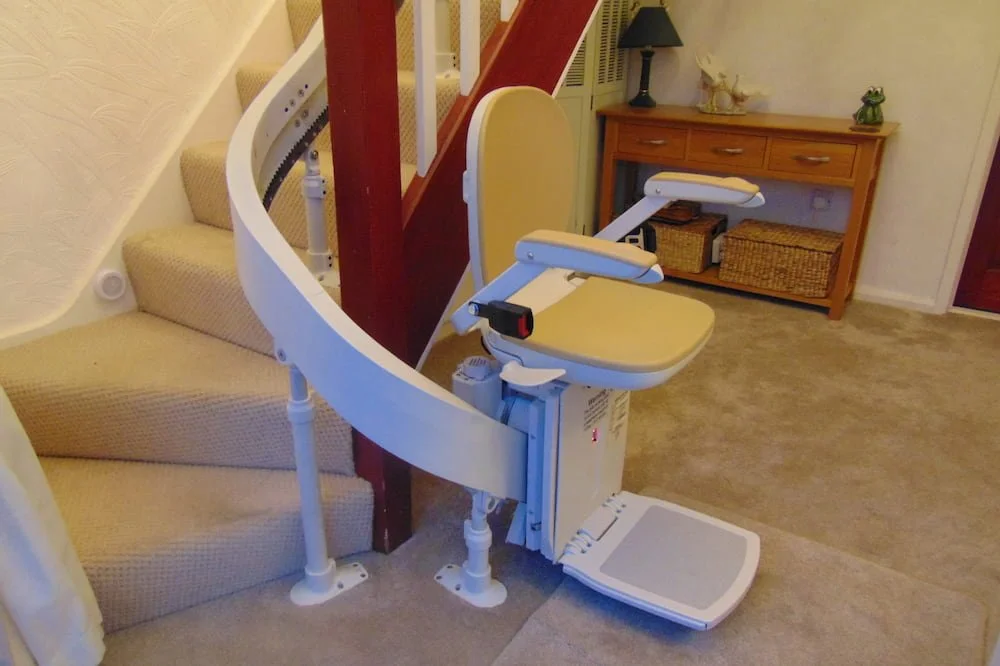
When stairlifts are installed on curved or spiral staircases, they are custom engineered. The rail is built specifically to follow the exact path of the stairs.
This precision allows the lift to hug the staircase closely, minimizing protrusion. However, even custom systems have limits. Extremely tight curves or narrow inner steps may still prevent safe installation.
Customization expands possibilities, but it does not override physics.
The Importance of Outer Edge Width
In spiral staircases, the outer edge of each step is wider than the inner edge. Stairlifts are typically positioned closer to this outer edge to maximize usable space.
If the outer edge provides enough consistent width for the rail and seat, installation may be possible. If it tapers too sharply or varies significantly, safety becomes a concern.
This is one of the first measurements professionals evaluate.
Clearance for Standing and Sitting
Safety is not just about the lift fitting the stairs. It is also about the user being able to sit comfortably and dismount safely.
At the top and bottom of a spiral staircase, space is often limited. There must be enough room for the seat to swivel and for the user to stand or step away without risk.
Limited landing space is a common reason spiral stairlifts are ruled out.
Weight Distribution and Structural Support
Spiral staircases often rely on a central column for support. This design can affect how weight is distributed.
Stairlifts must be securely anchored to stair treads that can support the load consistently. Some spiral staircases are not designed for this additional stress.
Structural integrity is evaluated carefully to protect both the user and the staircase.
Safety Always Comes First
Even when installation is technically possible, safety remains the deciding factor. If any part of the staircase introduces risk, professionals will recommend against installation.
This honesty is essential. Accessibility solutions should never compromise safety in the name of convenience.
Saying no is sometimes the most responsible answer.
When a Stairlift Is Not the Right Solution
In many spiral staircase homes, stairlifts are simply not the safest option. This does not mean accessibility is impossible.
Alternative solutions may include vertical platform lifts installed nearby, reconfiguring access points, or exploring relocation of key living spaces within the home.
The goal remains the same. Safe, reliable movement without unnecessary risk.
Preserving the Character of the Home
For many homeowners, the spiral staircase is more than a functional feature. It is part of the home’s identity.
Removing or altering it can feel like losing something meaningful. Exploring options that preserve the staircase while improving access elsewhere often feels more emotionally comfortable.
Respecting the home matters as much as solving the problem.
Emotional Weight of Hearing No
Being told that a stairlift cannot be installed on a spiral staircase can feel disappointing or even devastating. It can feel like the home itself is rejecting accessibility.
It is important to acknowledge that feeling. It is valid.
The next step is reframing the challenge. The limitation is not the person. It is the staircase design.
How Professionals Approach Spiral Staircase Assessments
Professional assessments are thorough and transparent. Measurements are taken carefully. Clearances are evaluated realistically.
Rather than promising solutions prematurely, professionals explain what is possible and why. This clarity builds trust, even when the answer is not what someone hoped to hear.
Assessment replaces guesswork.
Real Life Reflections From Spiral Staircase Homes
I once spoke with a homeowner whose spiral staircase could not accommodate a stairlift. They were initially discouraged. Later, they installed a vertical platform lift near the staircase, preserving its beauty while restoring access.
Another family discovered that their spiral staircase was wide enough at the outer edge for a custom curved stairlift. The solution worked beautifully and allowed them to stay in the home they loved.
Different homes lead to different answers.
Planning Ahead Matters More With Spiral Staircases
Because options are more limited, planning ahead becomes even more important. Waiting until stairs are no longer safe reduces flexibility.
Early assessment opens doors to solutions that might otherwise be overlooked.
Time creates options.
Avoiding DIY or Assumptions
Spiral staircases are not suitable for experimentation or DIY solutions. Attempting to force accessibility without professional guidance can lead to serious risk.
Expert evaluation protects everyone involved.
Safety is never optional.
When Alternative Access Feels Like the Right Choice
Sometimes the best solution is not on the staircase itself. It may be next to it. Or outside. Or in a different part of the home.
Accessibility does not have to follow the original path to be meaningful.
Flexibility leads to success.
Conclusion
A stairlift can sometimes be installed on a spiral staircase, but it depends entirely on the specific design, dimensions, and structural support of the stairs. While some spiral staircases can accommodate custom curved stairlifts, many cannot do so safely. Honest assessment, professional guidance, and openness to alternative solutions are essential.
At KGC, we believe accessibility decisions should respect both safety and the homes people love. Our approach includes careful evaluation of spiral staircases and clear guidance on whether a stairlift is possible or if another solution would better support long term independence. If you are navigating this question and want answers rooted in experience and care, our team is here to help.
You can reach our team through the KGC Contact Page.
